|
 The Rotary Foundation The Rotary Foundation
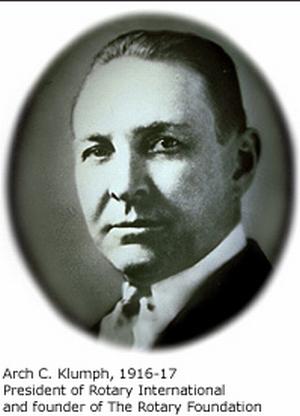 It was all Arch Klumph’s idea. As RI President in 1917, he told delegates to the Atlanta convention, “Carrying on as we are, a miscellaneous community service, it seems entirely proper that we should accept endowments for the purpose of doing good in the world.” It was hardly a stirring call to action or a motivational moment for those present. But it was the first pebble in what would later become a landslide of support that would improve millions of lives. It was all Arch Klumph’s idea. As RI President in 1917, he told delegates to the Atlanta convention, “Carrying on as we are, a miscellaneous community service, it seems entirely proper that we should accept endowments for the purpose of doing good in the world.” It was hardly a stirring call to action or a motivational moment for those present. But it was the first pebble in what would later become a landslide of support that would improve millions of lives.
Although the idea was accepted and endorsed by Rotary, it wasn’t until the death of Paul Harris in 1947, when Rotary International asked individuals and Clubs wishing to honour the founder to make gifts in his name to the Rotary foundation, that Arch Klumph’s vision was finally realised. Money poured in from all over the world and the foundation granted 18 Rotary Foundation Fellowships – later called Ambassadorial Scholarships – for one year’s university study abroad.
By 1948 contributions had exceeded US$1,775,000. In 1954 contributions reached US$500,000 in a single year allowing the Foundation to award 494 Ambassadorial Scholarships to young men and women from 57 countries. In 1957 the Foundation Trustees announced the creation of Paul Harris Fellowships for any one who contributed or had contributed on their behalf US$1,000 to the Foundation.
Ambassadorial Scholarships
Since 1947, when 18 “Rotary Fellows” left their homes in seven countries to study abroad, The Rotary Foundation has sent more than 35,000 Ambassadorial Scholars to help build understanding and peace in the global community. The Ambassadorial scholarships program has grown to become the largest privately funded international scholarships program in the world.
This unofficial “diplomatic corps” of young men and women excels not only in scholarship but in meeting humanitarian needs. Moreover, they have gone on to serve in the United Nations and other international organisations, government embassies, multinational corporations, and as doctors, teachers, and other professionals who help instil a broader world view in their communities.
Let there be peace on earth …
As the 21st century dawned, Rotarians realised that their commitment to aid the cause of peace was needed more than ever. Looking ahead, The Rotary Foundation established in conjunction with seven universities from around the world, including the University of Queensland, the Rotary Centres for International Studies in peace and conflict resolution. The Rotary Centres offer individuals who are committed to peace and co-operation the opportunity to pursue a fully funded, two-year master’s level degree or certificate in a field such as international studies, peace studies or conflict resolution. The first class in 2002 included 70 scholars from 35 countries.
University of Melbourne psychology graduate and researcher Ms Tania Miletic become Victoria's first ever recipient of a Rotary World Peace Scholarship. As a Rotary World Peace Scholar Ms Miletic is spending two years at the International Christian University (ICU) in Tokyo, undertaking a Masters degree program in international studies relating to peace and conflict resolution. Tania was nominated by the Rotary Club of Melbourne. District 9800 has successfully nominated two peace scholars since the program began.
Group Study Exchange (GSE)
The GSE program began in 1955 as the idea of a New Zealand district. Originally known as the Rotary Overseas Travel Award (ROTA), it was adopted by the Trustees as an official educational program in 1965.
As of the end of the 1999-2000 Rotary year, 8,063 teams had traveled, with another 587 scheduled for 2000-01. Through 1999-2000, 42,209 participants had taken advantage of the program, with 2,935 more alumni presumed for 2000-01. For 2001-02, more than 590 teams were paired, adding nearly 3,000 more participants to the total.
Expenditures through 1999-2000 were more than US$73 million. In 1999-2000 alone, the Foundation spent US$3,825,111.81 for the program.
GSE is the only free Foundation program for which all districts in good standing may apply.
Matching Grants
Through Matching Grants The Rotary Foundation matches contributions raised by Rotary clubs and districts for international service projects involving Rotary clubs or districts in two or more countries. Frequently, these are World Community Service (WCS) projects.
The Rotary Foundation provides a 1:1 for District Designated Funds SHARE contributions and a 0.5:1 match for new cash contributions.
Health, Hunger and Humanity (3-H) Grants
The Health, Hunger and Humanity (3-H) Grants program was the brainchild of 1978-79 RI President Clem (now Sir Clem) Renouf of Australia. Health, Hunger, and Humanity (3-H) Grants are awarded to fund long-term, self-help, and grassroots development projects that are too large for one club or district to implement on their own. Projects must be self-sustaining after the 3-H Grant funds have been expended. All projects must involve Rotary clubs and districts in at least two different countries with a significant number of Rotarians actively participating in the project.
3-H Grants range from US$100,000 to $300,000 and are considered twice annually and awarded in May and November.
PolioPlus
PolioPlus is Rotary’s massive effort to immunise the children of the world against poliomyelitis, with the goal of celebrating a polio-free world in our 100th anniversary year 2005. It is part of a global effort to protect the children from five other deadly diseases as well; measles, diphtheria, pertussis, tetanus, tuberculosis – the “plus” in PolioPlus. Rotary's pledge of US$120 million to fund its PolioPlus program was announced in October 1985 at the 40th anniversary of the United Nations. This ambitious commitment electrified the global public health community. Within three years, Rotarians had more than doubled their fundraising goal, donating US$247 million
In 1988, the World Health Organisation adopted a goal of eradicating polio throughout the world by the year 2000. Rotary works in partnership with national governments, the World and Pan American Health organisations, UNICEF and others.
In 1995 nearly 300 million children received oral polio vaccinations during national immunisation days conducted in 51 countries including China and India where 165 million children were immunised in one week. This represents almost 50 percent of all the world's children under the age of five.
In 1995, Rotary launched a task force to advocate polio eradication to donor governments, resulting in more than $1.5 billion in polio-specific grants from public sector advocacy . In 2000, Rotary teamed up with the United Nations Foundation to carry a financial appeal to the private sector — foundations, corporations, and wealthy individuals. The private sector has contributed more than $100 million to eradication efforts.
|
Donor Profile for Received and Confirmed Contributions, 1988-2005
|
|
Contribution (US$ million)
|
Public Sector Partners
|
Development Banks
|
Private Sector Partners
|
|
> 500
|
USA
|
|
Rotary International
|
|
250 — 500
|
Japan, United Kingdom
|
|
|
|
100 — 249
|
Netherlands
|
World Bank
|
|
|
50 — 99
|
Canada, Germany, European Commission
|
|
Bill & Melinda Gates Foundation
|
|
25 — 49
|
Denmark, UNICEF Regular Resources
|
|
United Nations Foundation
|
|
5 — 24
|
Australia, Belgium, France, Norway, WHO Regular Budget
|
Inter-American Development Bank
|
Aventis Pasteur, IFPMA, UNICEF National Committees
|
|
1 — 4
|
Ireland, Italy, Luxembourg, Russian Federation, Switzerland
|
|
Advantage Trust (HK), De Beers, Pew Charitable Trust Wyeth
|
Rotary is the largest nongovernmental financial contributor to the global polio eradication effort. By the time the world is certified polio-free, Rotary's contributions to the global polio eradication effort will exceed US$600 million and 5 million people who otherwise would have been paralyzed will be walking.
There are significant reasons to be optimistic about achieving our goal of global polio eradication by 2005.
1. The number of polio cases has been reduced by a projected 99 percent since Rotary and partner agencies formed the global polio eradication initiative — from 350,000 in 1988 to fewer than 1900 in 2002.
2. Three of six regions of the world are free of the wild poliovirus.
3. Despite intensive surveillance efforts, one of the three types of viruses (Type II) that cause polio has not been seen since 1999. Could it be that it has already been eradicated? The World Health Organization will continue to promote active surveillance to determine this possibility.
"Rotary's presence has been vital for the PolioPlus effort. Without Rotary, everything would have been different."
— Carol Bellamy,
Executive Director of UNICEF
The Share System
What makes The Rotary Foundation unique is its three-year funding cycle and the Foundation's mechanism for program participation, known in Rotary as SHARE. Through the three-year cycle, funds contributed in any given year are invested for three years before being spent on programs. This ensures that all contributed dollars go directly to programs; only investment earnings are used to pay administrative costs. In years in which the Foundation's investments have performed well, the Foundation has been able to channel extra monies into program awards.
SHARE is the system the Foundation uses to allocate Rotarian contributions toward programs. At the grassroots level, individuals are members of Rotary clubs. Rotary clubs are organized into administrative units known as districts. Foundation contributions are tabulated by district. At the end of the fiscal year, each district's contributions to the Annual Programs Fund is split, with 60 percent going to the district (to its District Designated Fund, or DDF) and 40 percent going to The Rotary Foundation (known as the World Fund, or WF). NOTE: Beginning in 2003-04, the SHARE split will change to 50 percent DDF and 50 percent WF.
Districts can choose from a wide variety of options as to how they wish to spend their DDF. The Foundation uses the World Fund to pay for certain program activities available to all Rotary districts. The system allows Rotary districts and the Foundation to SHARE in the process of deciding how best to use Rotarian contributions.
Success to date
The Rotary Foundation’s accomplishments are impressive. Nearly 36,000 scholars from 110 countries have received Ambassadorial Scholarships valued at US$429 million. More than 46,000 people have participated in 10,600 Group Study Exchange teams at a cost of more than $82 million, and 18,000 Matching Grant projects in 166 countries have been funded at a cost of more than $182 million. Through Polio Plus, Rotary has committed more than $500 million to global polio eradication efforts.
Since 1947, Rotarians have contributed more than US$1.4 billion to the Foundation, with total contributions averaging more than US$85 million annually. There are more than 800,000 Paul Harris Fellows, and new fellows are being added at the rate of 45,000 per year. The Rotary Foundation spends about $100 million annually on its programs and since 1917 has funded US$1.4 billion in program awards and expenses – yet still maintains net assets of almost $500 million.
For further information on the Rotary Foundation and how you can support it contact Club member Alex Buchanan.
|








;)
 For further information p